Home Battery Size Guide: Calculate What You Need in 2026
December 19, 2025 | info@gridless.com.au | Uncategorized Table of Contents
Choosing the right battery size for your home depends on your daily energy consumption, backup duration needs, and whether you want full or partial home coverage during outages.
Most Australian homes need between 10-15 kWh for essential appliances, while whole-home backup requires 20-30 kWh or more.
Want to reduce costs? Read our official blog about the cheaper home batteries program for available rebates.
How Much Battery Capacity Do You Actually Need?
Your battery size depends on three factors: what you want to power, how long you need backup, and your daily energy use.
Start with your daily consumption. Check your electricity bill for your average daily kWh usage. Most Australian households use 15-20 kWh per day, but this varies based on home size, occupants, and appliances.
Decide on your backup goal. Do you want to keep the lights on during short outages, or power your entire home for days? Your answer determines your battery size.
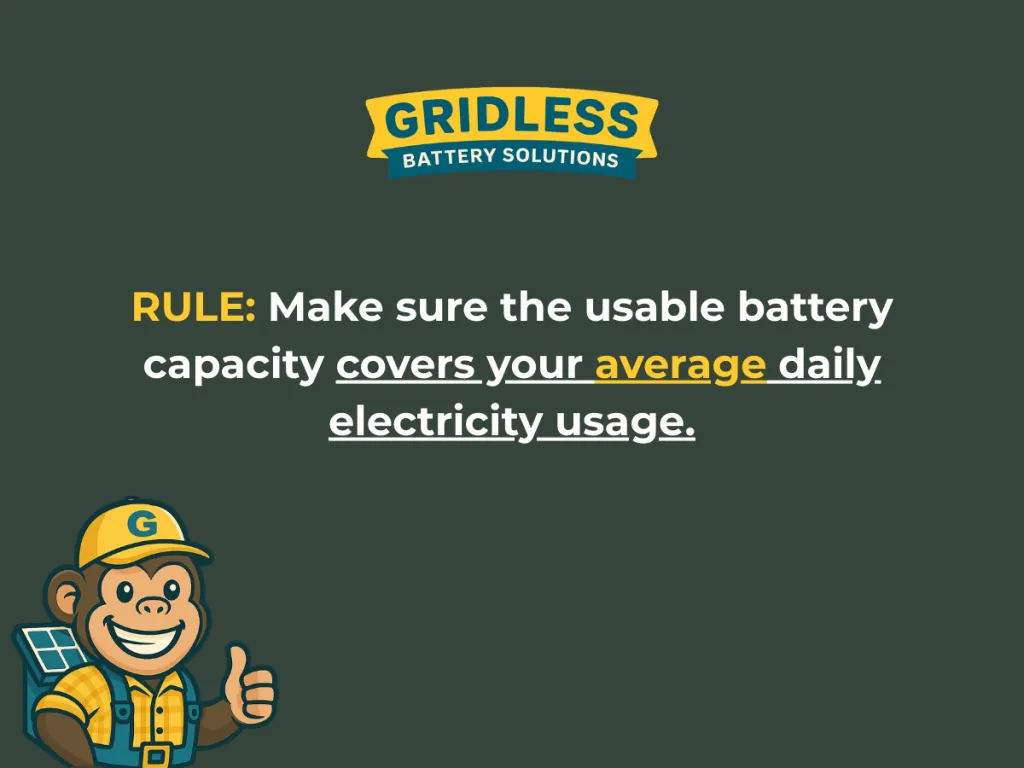
Here’s the math: If you use 20 kWh daily and want one day of backup, you need at least 20 kWh of usable capacity.
But batteries shouldn’t discharge completely, most systems use 80-90% of their rated capacity to protect battery health.
Example: A 13.5 kWh battery (like the Tesla Powerwall) provides about 12 kWh of usable energy. That covers 60% of a typical home’s daily needs or 100% of essential loads like lights, fridge, and internet.
Essential Backup vs. Whole-Home Coverage
Essential backup (8-13 kWh) covers critical circuits:
- Refrigerator and freezer
- Lighting in main rooms
- Internet and phone charging
- Medical equipment
- One window air conditioner or fan
Whole-home backup (20-30+ kWh) runs everything:
- Central air conditioning or heating
- Electric stove and oven
- Washing machine and dryer
- Pool pump
- Electric vehicle charging
- All lights and outlets
You’ll need multiple batteries or a single large-capacity unit.
Most homeowners choose the middle path: 13-20 kWh systems that cover essentials plus one or two comfort items like AC or heating.
Calculate Your Backup Runtime
Use this formula to estimate how long your battery will last:
Usable Battery Capacity ÷ Hourly Power Draw = Hours of Backup
Real example: You have a 10 kWh battery (9 kWh usable) and want to power:
- Fridge: 150W
- Lights: 200W
- Internet/phones: 50W
- TV: 100W
Total draw: 500W (0.5 kW)
Runtime: 9 kWh ÷ 0.5 kW = 18 hours
Add air conditioning (1,500W) and your runtime drops to 4 hours.
This shows why appliance selection matters for backup planning.
Common Battery Sizes and What They Power
5-7 kWh Systems
Best for: Small homes, apartments, off-grid cabins
Powers: Essential lights, fridge, internet for 6-10 hours
10-14 kWh Systems
Best for: Average 3-bedroom homes
Powers: All essentials plus one major appliance for 8-16 hours
15-20 kWh Systems
Best for: Larger homes, high energy users
Powers: Most of the home except heavy draws like pool pumps and central AC
20-30+ kWh Systems
Best for: Whole-home backup, extended outages, off-grid living
Powers: Everything including AC, heating, and EV charging
How Solar Affects Your Battery Size Choice
Solar panels change your battery strategy completely.
Without solar: Your battery only provides backup during outages. Size it for emergency needs only, typically 10-15 kWh.
With solar: Your battery stores excess solar energy for nighttime use. Size it based on your evening and overnight consumption—typically 40-60% of your daily usage.
Example: Your home uses 18 kWh daily. Solar produces 25 kWh on average days. You use 8 kWh during solar production hours and 10 kWh in the evening/night. A 10-13 kWh battery handles your after-dark needs perfectly.
Oversizing wastes money. A battery too large for your solar system won’t fill completely, and you’re paying for unused capacity.
The sweet spot: Battery capacity that matches 60-80% of your solar system’s daily production. This maximizes self-consumption without overinvestment.
Peak Demand vs. Continuous Power
Battery size isn’t just about capacity, it’s also about power output (measured in kW).
Capacity (kWh): How long your battery lasts
Power (kW): How much it can deliver at once
A 13.5 kWh battery might only output 5 kW continuously.
If your air conditioner draws 3.5 kW and your oven draws 2.5 kW, you can’t run both simultaneously, even though you have plenty of stored energy.
Check peak power ratings:
- Basic systems: 3-5 kW continuous (covers essentials)
- Standard systems: 5-7 kW continuous (runs most homes)
- High-power systems: 10+ kW continuous (handles multiple heavy loads)
Your battery needs enough power output to handle your home’s peak demand, not just average consumption.
Future-Proofing Your Battery Investment
Consider these factors before settling on a size:
Expansion capability: Some systems let you add batteries later. Start with one unit and expand if needed.
EV charging plans: If you’re buying an electric car within 5 years, add 10-15 kWh capacity now. Charging a Tesla Model 3 from 20% to 80% requires about 40 kWh, your battery won’t fully charge an EV, but it supplements grid charging.
Home additions: Planning a pool, workshop, or home office? Add 20-30% to your calculated battery size.
Energy usage trends: Most households increase electricity consumption by 2-3% annually. A slightly oversized battery today becomes perfectly sized in 3-5 years.
Cost vs. Value: Finding Your Budget Balance
Bigger isn’t always better when it comes to batteries.
- Solar self-consumption (avoiding 25-35¢/kWh grid power)
- Peak shaving (dodging demand charges)
- Feed-in tariff optimization
Unless you frequently experience outages or have high time-of-use rates, smaller systems make more financial sense.
Buy for reliability, not just savings. The real value of batteries is peace of mind during blackouts, not necessarily ROI.
Battery Sizing Mistakes to Avoid
Mistake 1: Trusting advertised capacity without checking usable capacity
A battery labeled “10 kWh” might only deliver 8-9 kWh of actual usable energy.
Here’s why: manufacturers advertise total capacity, but the usable capacity is what matters for your home.
Good news, most modern home batteries claim 100% Depth of Discharge (DoD).
This sounds perfect, but there’s a catch.
Smart manufacturers include hidden buffer capacity to protect the battery cells.
When they say “10 kWh with 100% DoD,” they’ve actually installed 11-12 kWh of physical capacity and only let you use 10 kWh.
Always check the specification sheet. Look for these terms:
- “Usable capacity” or “usable energy”
- “Depth of Discharge” or “DoD”
- “Round-trip efficiency”
Example: The Tesla Powerwall 2 advertises 13.5 kWh total capacity with 100% DoD, giving you 13.5 kWh usable. But older battery models might advertise 10 kWh with only 90% DoD, meaning you can only use 9 kWh safely.
Mistake 2: Ignoring minimum state of charge requirements
Most home batteries won’t let you drain them completely, even if they claim 100% DoD.
They maintain a minimum state of charge (usually 5-10%) as a safety reserve for:
- Battery management system operation
- Emergency backup functions
- Cell protection during power surges
- Firmware updates and system health checks
This reserve is typically hidden from users, but it means your “10 kWh” battery might only provide 9.5 kWh in real-world scenarios before the system forces a shutdown.
Check your battery’s emergency reserve settings. Some systems let you adjust this threshold, setting it lower gives you more usable capacity but may reduce battery lifespan.
Mistake 3: Not planning for battery degradation
Every lithium-ion battery loses capacity over time, even with perfect care.
After 10 years, your 10 kWh battery might only store 7-8 kWh. This isn’t a defect, it’s chemistry.
Degradation rates by battery type:
- NMC (Nickel Manganese Cobalt): 2-3% capacity loss per year → 70-80% capacity after 10 years
- LFP (Lithium Iron Phosphate): 1-2% capacity loss per year → 80-90% capacity after 10 years
Real example: You install a 13 kWh battery today that perfectly covers your evening needs. In year 10, it only holds 10 kWh. Suddenly, you’re running out of power before bedtime.
Smart sizing strategy: Add 20-25% extra capacity upfront to account for future degradation. If you need 10 kWh today, install 12-13 kWh. Your system will still meet your needs a decade from now.
Factors that accelerate degradation:
- Frequent full charge/discharge cycles
- Operating in extreme temperatures (above 35°C/95°F)
- Leaving battery at 100% charge for extended periods
- Rapid charging/discharging at maximum power rates
Mistake 4: Assuming solar will always cover daytime usage
You might think: “My battery won’t need to cover all my daily energy usage because my solar panels will handle daytime loads.”
That’s true on sunny days, especially in summer. But it won’t be summer every day.
Consider these scenarios:
- Winter production drops 40-60% compared to summer peak
- Cloudy weeks can reduce solar output by 70-80%
- Dust, debris, or shading from new construction cuts production
- Panel degradation reduces output by 0.5-1% annually
Real example: Your solar system produces 30 kWh on perfect summer days but only 12 kWh on cloudy winter days. If you sized your battery assuming summer production, you’ll run out of power during winter evenings.
Size for worst-case scenarios, not best-case. Use winter solar production figures when calculating battery needs, or add 30-40% buffer capacity to handle seasonal variations.
Mistake 5: Sizing based on daily consumption alone
You don’t need a battery that covers your entire 20 kWh daily usage, you need one that covers your non-solar hours.
Break down your consumption:
- Daytime (8am-5pm): Covered by solar
- Evening peak (5pm-10pm): 60% of battery drain
- Overnight (10pm-8am): 40% of battery drain
If you use 20 kWh daily but solar covers 12 kWh during production hours, you only need 8-10 kWh of battery storage for the remaining evening/overnight period.
But remember: Add that 20-25% buffer for degradation and seasonal variations. Your 8 kWh need becomes a 10 kWh battery purchase.
Mistake 6: Buying the cheapest battery without comparing chemistry
Not all lithium batteries are equal. Chemistry determines lifespan, safety, and performance.
NMC batteries (cheaper upfront):
- 3,000-4,000 cycles before 80% capacity
- Higher energy density (smaller physical size)
- More sensitive to temperature
- Slightly higher fire risk
LFP batteries (better long-term value):
- 6,000-10,000 cycles before 80% capacity
- Safer chemistry with better thermal stability
- Handles Australian heat better
- Costs 10-20% more upfront but lasts twice as long
The “expensive” battery is actually cheaper.
Mistake 7: Installing batteries in unconditioned spaces
Batteries in hot garages or cold outdoor locations lose 10-20% capacity and degrade faster.
Optimal operating temperature: 15-25°C (59-77°F)
Temperature impact:
- Above 30°C: Accelerated degradation, reduced lifespan
- Above 40°C: Capacity drops 15-20%, safety risks increase
- Below 0°C: Significantly reduced power output, charging disabled
Best locations:
- Climate-controlled garage or utility room
- Shaded exterior wall with ventilation
- Insulated outdoor enclosure with temperature management
Many Australians lose thousands in battery value by mounting systems on north-facing walls in direct sun. A simple shade structure adds 2-3 years of useful life.
Mistake 8: Not accounting for expansion costs
Adding a second battery later costs more than installing two upfront.
Why expansion is expensive:
If you’ll eventually want 20 kWh, install 20 kWh now. Installing once can cost less than adding capacity later, and you avoid future compatibility issues.
Mistake 9: Overlooking warranty capacity thresholds
Most battery warranties guarantee 70-80% capacity retention after 10 years, but with conditions:
- Cycle limits: 4,000-10,000 full cycles
- Throughput limits: Some warranties cap total energy throughput (e.g., 37,800 kWh for Tesla Powerwall 2)
- Installation requirements: Must be installed by certified professionals
- Operating conditions: Voided if outside temperature/voltage specifications
Calculate warranty value: A 10 kWh battery cycling once daily uses 3,650 kWh annually. After 10 years, that’s 36,500 kWh—right at warranty throughput limits for some brands. Heavy users might exceed warranty limits in 7-8 years, leaving them unprotected.
Read warranty fine print before buying. Higher cycle count warranties (8,000+) or unlimited throughput warranties offer better long-term value for heavy users.
Step-by-Step Battery Sizing Process
Step 1: List your critical loads and their wattage (check appliance labels or use a power meter).
Step 2: Add up the wattage of items you must power during an outage.
Step 3: Multiply by your desired backup hours to get total watt-hours needed.
Step 4: Convert to kWh (divide by 1,000).
Step 5: Add 20% buffer for inefficiencies and depth-of-discharge limits.
Step 6: Compare to your solar production (if applicable) to ensure compatibility.
Step 7: Check battery power output (kW) matches your home’s peak demand.
Example walkthrough:
- Critical loads: 2,500W
- Desired backup: 8 hours
- Total need: 20,000 Wh = 20 kWh
- With 20% buffer: 24 kWh
- Recommended system: Two 13 kWh batteries or one 25+ kWh unit
Next Steps
Choosing the right battery size for your home starts with an honest assessment of your backup needs and daily consumption patterns.
Most Australian homes find their sweet spot between 10-15 kWh for essential coverage or 20-30 kWh for whole-home backup.
Size your system based on what you actually need to power, not theoretical maximums, and remember that batteries provide peace of mind first and cost savings second.
Ready to move forward? request a quote and custom battery sizing quote from our certified energy experts today.
request a quote
PEOPLE ALSO ASK
What size battery do I need to run my house?
Most Australian homes need 10-15 kWh of battery capacity to power essential appliances during outages, including refrigerators, lights, internet, and one major appliance.
For whole-home backup including air conditioning and all circuits, you’ll need 20-30 kWh or more.
Calculate your needs by adding up the wattage of appliances you want to power and multiplying by your desired backup hours.
How long will a 10kWh battery power a house?
A 10 kWh battery (providing about 9 kWh usable capacity) will power essential loads drawing 1,000W for approximately 9 hours, or your entire home drawing 3,000W for about 3 hours.
Runtime depends entirely on what you’re powering; running just a fridge, lights, and internet could last 18+ hours, while adding air conditioning reduces runtime to 4-6 hours.
Is a 13.5 kWh battery enough?
A 13.5 kWh battery is sufficient for most average-sized Australian homes when used for essential backup or solar self-consumption.
It covers critical loads like refrigeration, lighting, internet, and one major appliance for 8-16 hours during outages.
It’s also ideal for storing excess solar energy for evening use in homes consuming 15-20 kWh daily.
However, it likely won’t power your entire home including central AC and heavy appliances simultaneously.
How many kWh battery to go off-grid?
Off-grid homes typically need 30-50 kWh of battery storage to cover 2-3 days without solar production (cloudy weather contingency).
The exact size depends on your daily consumption; multiply your average daily kWh usage by 2.5-3 for adequate autonomy.
A household using 20 kWh daily should install 50-60 kWh minimum, plus oversized solar arrays to recharge batteries during limited sun hours.
What happens if my battery is too small?
An undersized battery will drain completely during extended outages or high-demand periods, leaving you without backup power when you need it most.
With solar systems, a too-small battery won’t store all your excess solar energy, meaning you’ll export more to the grid at low feed-in tariff rates instead of using it yourself at night.
This reduces your ROI and energy independence.
Can I add more batteries later?
Most modern battery systems are modular and allow expansion, but compatibility matters.
Brands like Tesla Powerwall, Enphase, and Sonnen support adding units later if you purchase the same model and generation.
However, mixing brands or technologies isn’t possible, and installation costs for adding batteries later typically exceed installing multiple units initially.
Check expansion capabilities before your first purchase.
Share on Facebook Facebook Share on Email Email Share on Linkedin Linkedin 𝕏 Share on X Xinfo@gridless.com.au
Related Posts
 17 Dec Solar Battery Installation Australia 2026: Why Now Is The Best Time Installing a solar battery in Australia has never... Read More about Solar Battery Installation Australia 2026: Why Now Is The Best Time
 17 Dec Charge Electric Car With Solar Battery in Australia Can I charge my electric car with solar... Read More about Charge Electric Car With Solar Battery in Australia
 17 Dec Solar battery finance: what to check before you sign...
 16 Dec How Long Do Solar Batteries Really Last? (Real Data, Not Sales Talk) Short answer: Most modern solar batteries last 15-17... Read More about How Long Do Solar Batteries Really Last? (Real Data, Not Sales Talk)

Request a Quote
"*" indicates required fields
Contact Us Today!
At Gridless, we’re passionate about helping Australian homes achieve comfort and efficiency. We offer a range of high-quality heat pump hot water systems and air conditioning solutions to meet your specific needs. Solar and battery installation is available Australia-wide. Heat pump hot water installation covers metropolitan Melbourne.
Call Your Home's Best Friend+61 3 4150 3720
Email:info@gridless.com.au